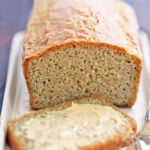
Simple Almond Flour Bread
This simple almond flour bread comes together quickly with basic pantry ingredients and keeps well in the fridge or freezer.
Servings 12 slices
Calories 162kcal
Ingredients
- 5 large eggs
- 5 tablespoons salted butter melted and slightly cooled
- 1 teaspoon apple cider vinegar helps the bread rise
- ⅛ teaspoon sea salt
- 7 ounces superfine almond flour 1 ¾ cup; please measure by weight
- ½ teaspoon baking soda see the notes section below
Instructions
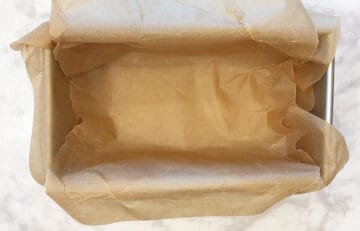
- Preheat the oven to 350°F. Grease an 8-inch loaf pan and line it with parchment paper, leaving an overhang for easy removal. The notes section below contains instructions for adjusting this recipe to a standard 9-inch loaf pan.
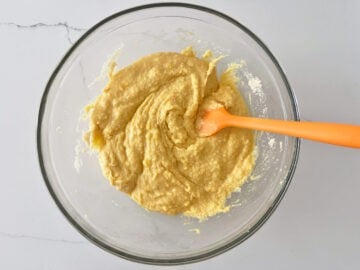
- In a medium bowl, whisk the eggs until well incorporated. Whisk in the melted butter, vinegar, and salt.5 large eggs, 5 tablespoons salted butter, 1 teaspoon apple cider vinegar, ⅛ teaspoon sea salt

- Gradually add the almond flour, then mix in the baking soda. The batter should be thick but not dry. If it's too thick for the whisk, switch to a rubber spatula. If it's dry, add a tablespoon of water.7 ounces superfine almond flour, ½ teaspoon baking soda
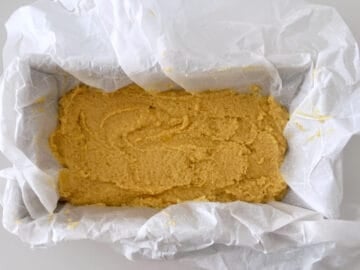
- Quickly transfer the batter to the prepared pan. Smooth the top with a spatula. You'll want to place the bread in the oven ASAP, since the baking soda has already started reacting with the vinegar.
- Bake until the bread is puffed and set and a toothpick inserted in its center comes out clean, about 30 minutes. The notes section below contains instructions for adjusting the baking time.
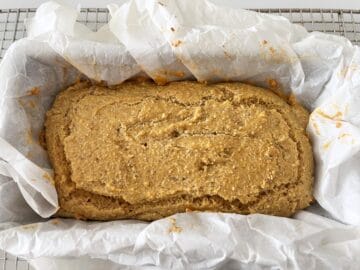
- Cool the bread for 10 minutes in the pan on a wire rack, then gently release it. Cool it for an additional 10 minutes before slicing and serving. Its texture improves as it cools and settles. It’s delicious when served warm, but not hot straight out of the oven.

Video
Notes
- Seasonings, especially salt, are guidelines. Adjust to taste.
- I use Bob's Red Mill Super-Fine Almond Flour. One cup of this flour weighs 4 ounces, so 1 ¾ cups weigh 7 ounces. It's best to measure almond flour by weight and not by volume.
- If you don’t have a kitchen scale, use the spoon-and-level method to measure the flour. Gently stir it in its container to loosen it. Then, using a spoon, lightly scoop the flour into your measuring cup without pressing it down. Once the cup is slightly overflowing, use the flat edge of a knife to level it off. Avoid dipping the measuring cup directly into the bag, as this can pack the flour and lead to using more than the recipe calls for.
- Occasionally, baking soda can cause a reaction in baked goods, resulting in an ammonia smell. It can also give the bread a slight green tint. Both reactions are harmless and can be avoided by substituting 2 teaspoons of fresh, aluminum-free baking powder for the baking soda and omitting the vinegar. The crust will not brown as much if using baking powder.
- You can use a 9x5-inch loaf pan and adjust the recipe as follows: Use 7 large eggs, 7 tablespoons of melted butter, 10 ounces of almond flour, and 2 teaspoons of baking powder. If the batter is dry, add an extra egg for a total of 8. Bake the bread for 30 minutes at 350°F, then check with a toothpick to see if it's done. Remember that the nutrition information will change.
- Almond flour tends to create a softer, cake-like texture since it’s gluten-free and lacks the elasticity of wheat flour. Adding a tablespoon of psyllium husk powder helps create a more elastic, chewy crumb. If you'd like to use it, add 2 tablespoons of water to balance the extra absorbency, and let the batter rest for 5 minutes before transferring it to the pan, allowing the psyllium to fully hydrate.
- The baking time for the bread depends on your oven. When I started making this recipe, I used an old oven and baked it for 45 minutes. I have since moved, and it only takes 30 minutes in my new oven. Oven temperatures vary, so start checking after 30 minutes.
- Storage: Once completely cooled, place the bread in an airtight container or a large resealable bag and store it in the fridge for up to five days. To freeze, slice the cooled bread, wrap each slice individually in plastic wrap, and then put all the slices in a freezer bag. When ready to eat, briefly reheat a slice in the microwave or toast it.
Nutrition
Serving: 1slice | Calories: 162kcal | Carbohydrates: 4g | Protein: 6g | Fat: 15g | Saturated Fat: 4g | Sodium: 133mg | Fiber: 2g | Sugar: 1g
